• New headquarters of Credito Italiano

    New headquarters
    of Credito Italiano

  • New headquarters of Credito Italiano

    New headquarters
    of Credito Italiano

  • New headquarters of Credito Italiano

    New headquarters
    of Credito Italiano

New headquarters of Credito Italiano

A landmark project
in the history of the firm

The intervention, which involved a prestigious city block in the heart of Milan, was the first in a long and fruitful collaboration between Studio A. Ferraresi – AF Engineering and various financial and insurance institutions. The expansion presented significant complexity due both to its scale and the need to preserve and incorporate some historically and architecturally valuable elements.

In 2023, the entire block underwent a further transformation with the project The Medelan, once again overseen by Studio A. Ferraresi – AF Engineering.

  • Type:

    Banks

  • Location:

    Piazza Cordusio / Via Broletto /
    Via San Protaso / Via Santa Margherita / Via T. Grossi, Milan

  • Year:

    1960-1968; 2006

  • Client:

    Credito Italiano

Credito Italiano la terrazza

Project Features

From Palazzo Broggi to a modern complex

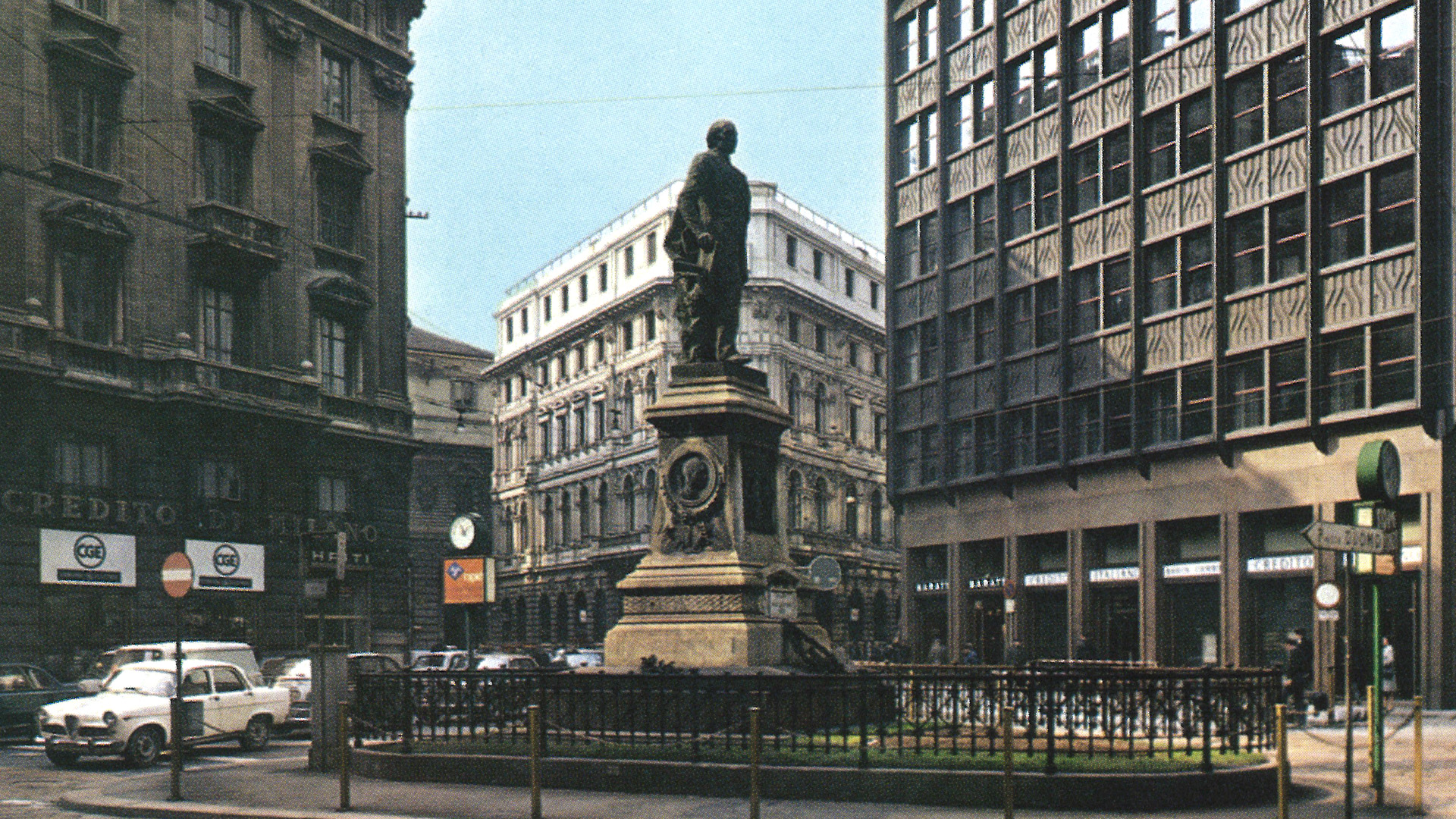
The first headquarters of Credito Italiano, overlooking the scenic ellipse of Piazza Cordusio, was originally built in 1903 in an eclectic style by architect Luigi Broggi. During the subsequent decades the bank incorporated numerous adjacent buildings in the block behind, toward the Galleria Vittorio Emanuele II and Teatro alla Scala.

In the late 1950s, the need for new office space for administrative staff, vaults and an additional public counter hall required the construction of a new complex with a more rational distribution. It was essential to ensure volumetric continuity with the pre-existing constructions, while integrating the cast-iron façade of the former Magazzini Contratti building on Via Tommaso Grossi  –  a valuable example of art nouveau architecture by Luigi Broggi.


Architectural design

The intervention initially provided for the complete emptying of the block, with the exception of Broggi’s historic building. To this was connected a new large complex designed by the Technical Office of Credito Italiano in collaboration with Giovanni Muzio, a master of 20th-century Italian architecture. Various building volumes of six above-ground floors were arranged along the perimeter of the block, surrounding a taller central body with a dome roof housing technical facilities.

Flexible distribution and harmony with context

All office floors, designed for maximum flexibility with movable partitions, were served by wide corridors forming a continuous ring-shaped circulation. The external façades were carefully studied to harmonise with the surrounding urban fabric, characterised largely by dignified representative architecture from the late 19th and early 20th centuries that defines central Milan. For this reason, materials were selected that develop a historical and textured patina over time:  copper for the areas beneath windows and curtain-wall ribs, bronze for window frames, and pink granite for the ground-floor cladding.

Of particular interest is the multi-storey base that occupies the entire lot and houses garages, vaults with reinforced slabs and walls, technological centres and archives.


A highly demanding construction site

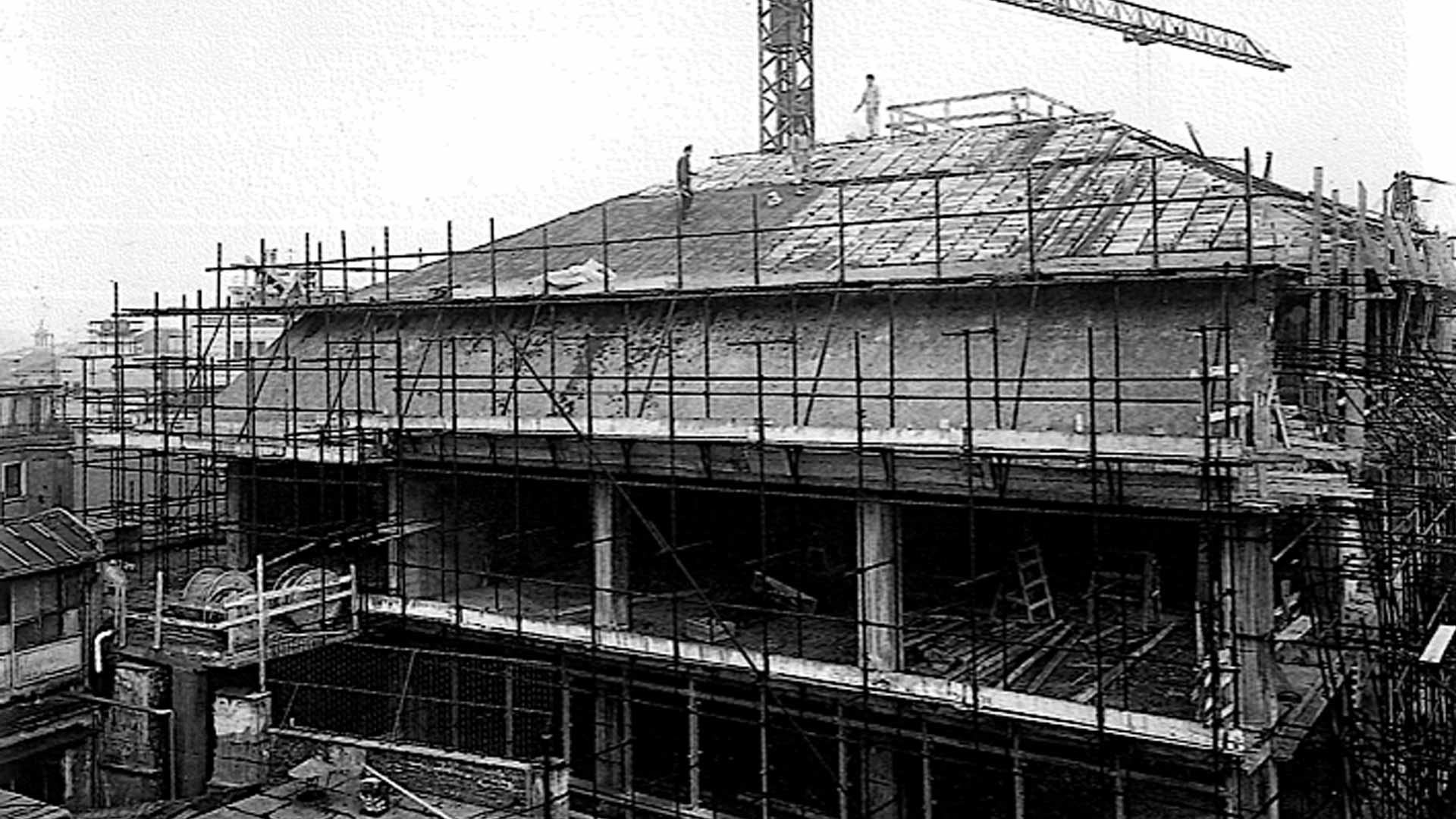
Studio A. Ferraresi – AF Engineering’s assignment involved the design and supervision of the structures. Between 1963 and 1968, operating in two phases, the entire block was emptied and reconstructed with a foundation system of inverted beams, cross-ribbed reinforced concrete slabs and reinforced concrete beams.

Highly demanding was the management of the construction site, located within narrow, high-traffic central streets with adjacent multi-storey buildings and limited manoeuvering space, which made it impossible to work with conventional construction equipment. Another challenge was the notable depth of the foundation excavation, reaching 23 metres below street level. To support the ground during construction, it was necessary to install reinforced-concrete diaphragm walls, cast along the entire perimeter of the area using bentonite slurry. As excavation progressed, the diaphragm walls were reinforced with strutting systems and ground anchors driven into the soil.

From Palazzo Broggi to a modern complex

The first headquarters of Credito Italiano, overlooking the scenic ellipse of Piazza Cordusio, was originally built in 1903 in an eclectic style by architect Luigi Broggi. During the subsequent decades the bank incorporated numerous adjacent buildings in the block behind, toward the Galleria Vittorio Emanuele II and Teatro alla Scala.

In the late 1950s, the need for new office space for administrative staff, vaults and an additional public counter hall required the construction of a new complex with a more rational distribution. It was essential to ensure volumetric continuity with the pre-existing constructions, while integrating the cast-iron façade of the former Magazzini Contratti building on Via Tommaso Grossi  –  a valuable example of art nouveau architecture by Luigi Broggi.


Architectural design

The intervention initially provided for the complete emptying of the block, with the exception of Broggi’s historic building. To this was connected a new large complex designed by the Technical Office of Credito Italiano in collaboration with Giovanni Muzio, a master of 20th-century Italian architecture. Various building volumes of six above-ground floors were arranged along the perimeter of the block, surrounding a taller central body with a dome roof housing technical facilities.


Flexible distribution and harmony with context

All office floors, designed for maximum flexibility with movable partitions, were served by wide corridors forming a continuous ring-shaped circulation. The external façades were carefully studied to harmonise with the surrounding urban fabric, characterised largely by dignified representative architecture from the late 19th and early 20th centuries that defines central Milan. For this reason, materials were selected that develop a historical and textured patina over time:  copper for the areas beneath windows and curtain-wall ribs, bronze for window frames, and pink granite for the ground-floor cladding.

Of particular interest is the multi-storey base that occupies the entire lot and houses garages, vaults with reinforced slabs and walls, technological centres and archives.


A highly demanding construction site

Studio A. Ferraresi – AF Engineering’s assignment involved the design and supervision of the structures. Between 1963 and 1968, operating in two phases, the entire block was emptied and reconstructed with a foundation system of inverted beams, cross-ribbed reinforced concrete slabs and reinforced concrete beams.

Highly demanding was the management of the construction site, located within narrow, high-traffic central streets with adjacent multi-storey buildings and limited manoeuvering space, which made it impossible to work with conventional construction equipment. Another challenge was the notable depth of the foundation excavation, reaching 23 metres below street level. To support the ground during construction, it was necessary to install reinforced-concrete diaphragm walls, cast along the entire perimeter of the area using bentonite slurry. As excavation progressed, the diaphragm walls were reinforced with strutting systems and ground anchors driven into the soil.

  • Credito Italiano progetto
  • Credito Italiano progetto
  • Credito Italiano progetto
  • Credito Italiano ampliamento
  • Credito Italiano il cantiere
  • Credito Italiano ristrutturazioni
  • Credito Italiano panoramica della terrazza
  • Credito Italiano la facciata
  • Credito Italiano particolari
  • Credito Italiano facciata
  • Credito Italiano spazi interni

Preservation of an art nouveau jewel

An even more complex operation concerned the preservation of the façade of the Magazzini Contratti store: before demolishing the internal building, an underground diaphragm wall was constructed parallel to Via Tommaso Grossi down to a depth of –23 metres. Perpendicular walls were then built to support a temporary reinforced-concrete structure, onto which the façade was anchored. The façade was thus kept in perfect vertical alignment and prepared for its final connection to the new reinforced-concrete structures behind it, after which the temporary supporting structure was removed.


From Credito Italiano to UniCredit

The trusted relationship between Studio A. Ferraresi – AF Engineering and Credito Italiano continued through the 1960s and 1970s with the construction of new offices on Via Broletto and a training centre in the historic Villa Gerno in Lesmo. After the bank’s merger into the UniCredit group, in the 2006 Studio A. Ferraresi – AF Engineering was again commissioned  to handle the detailed design of a new public lounge and a large lecture hall in Piazza Cordusio.

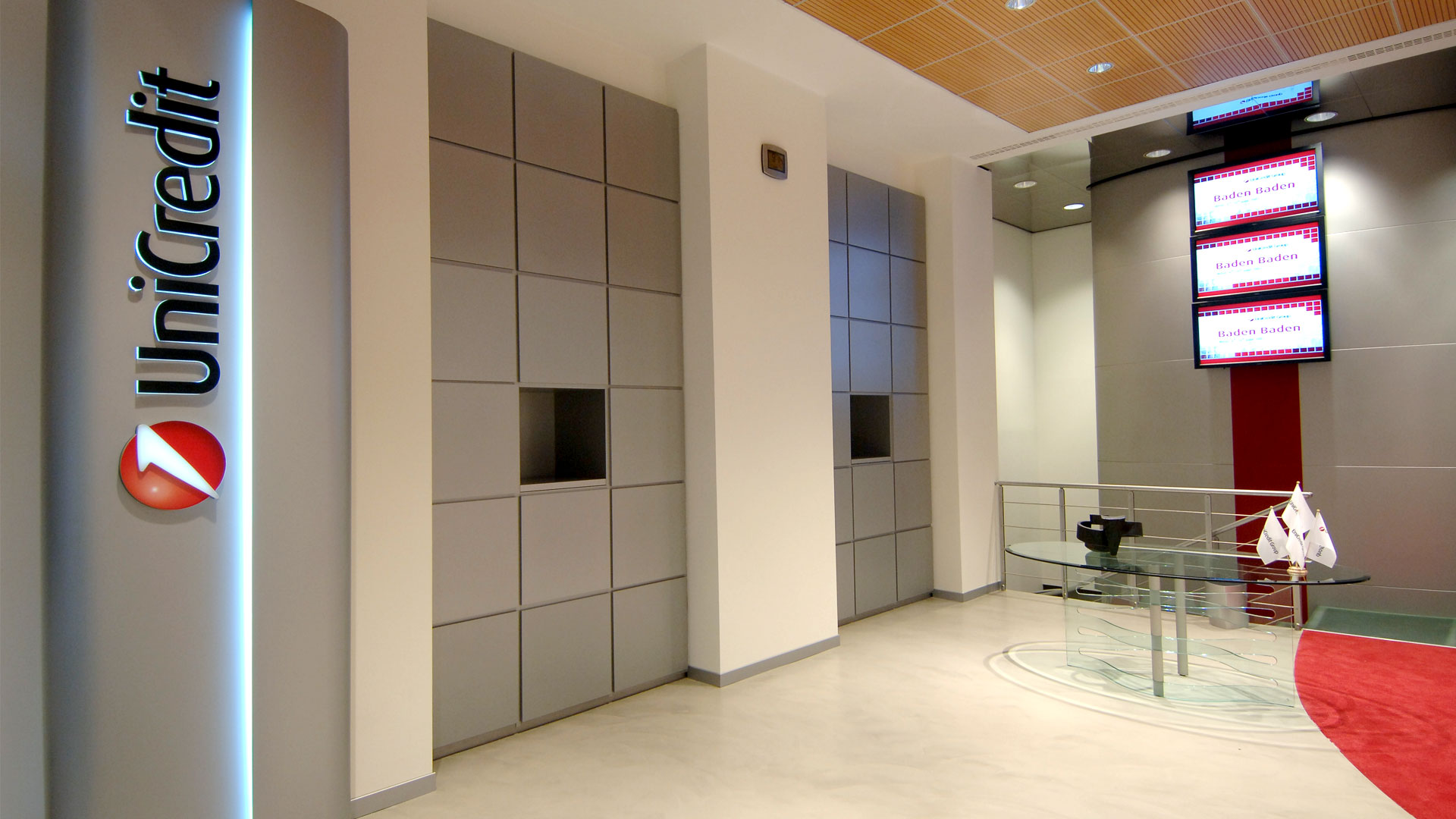
New public hall

The hall, accessed from the scenic frontage of Palazzo Broggi, required a new image capable of conveying the identity and values of UniCredit, one of Italy’s largest banking groups. Studio A. Ferraresi – AF Engineering supported the exhibition designer (Studio Sighinolfi) with administrative procedures, structural design and construction supervision.
The need to maintain the continuous operation of the bank branch during the works – appropriately compartmentalised for security reasons – and to comply with a very tight schedule, with only seven months from the start of design to completion, required a considerable effort. The widespread deterioration of the century-old structures suggested starting not from a fully developed detailed project, but from a simple concept design, which was progressively developed into a detailed design as demolition works advanced. This method, which proved highly effective, required close and continuous collaboration between the architectural designer and the engineering team.


Auditorium

The “aula magna” was created by merging two underused spaces on the ground floor of Giovanni Muzio’s central building. Studio A. Ferraresi – AF Engineering worked alongside UniCredit’s Technical Office on administrative procedures, structural calculations and construction supervision. The new space, equipped with movable partitions, featured multimedia workstations and high-quality finishes. In addition to the very short execution time (five months), the project required coordinating the work of numerous parties (construction companies, building services engineers, installers of movable partitions and IT systems) and harmonising the client’s requirements, which were distributed among multiple stakeholders.

Preservation of an art nouveau jewel

An even more complex operation concerned the preservation of the façade of the Magazzini Contratti store: before demolishing the internal building, an underground diaphragm wall was constructed parallel to Via Tommaso Grossi down to a depth of –23 metres. Perpendicular walls were then built to support a temporary reinforced-concrete structure, onto which the façade was anchored. The façade was thus kept in perfect vertical alignment and prepared for its final connection to the new reinforced-concrete structures behind it, after which the temporary supporting structure was removed.


From Credito Italiano to UniCredit

The trusted relationship between Studio A. Ferraresi – AF Engineering and Credito Italiano continued through the 1960s and 1970s with the construction of new offices on Via Broletto and a training centre in the historic Villa Gerno in Lesmo. After the bank’s merger into the UniCredit group, in the 2006 Studio A. Ferraresi – AF Engineering was again commissioned  to handle the detailed design of a new public lounge and a large lecture hall in Piazza Cordusio.


New public hall

The hall, accessed from the scenic frontage of Palazzo Broggi, required a new image capable of conveying the identity and values of UniCredit, one of Italy’s largest banking groups. Studio A. Ferraresi – AF Engineering supported the exhibition designer (Studio Sighinolfi) with administrative procedures, structural design and construction supervision.
The need to maintain the continuous operation of the bank branch during the works – appropriately compartmentalised for security reasons – and to comply with a very tight schedule, with only seven months from the start of design to completion, required a considerable effort. The widespread deterioration of the century-old structures suggested starting not from a fully developed detailed project, but from a simple concept design, which was progressively developed into a detailed design as demolition works advanced. This method, which proved highly effective, required close and continuous collaboration between the architectural designer and the engineering team.


Auditorium

The “aula magna” was created by merging two underused spaces on the ground floor of Giovanni Muzio’s central building. Studio A. Ferraresi – AF Engineering worked alongside UniCredit’s Technical Office on administrative procedures, structural calculations and construction supervision. The new space, equipped with movable partitions, featured multimedia workstations and high-quality finishes. In addition to the very short execution time (five months), the project required coordinating the work of numerous parties (construction companies, building services engineers, installers of movable partitions and IT systems) and harmonising the client’s requirements, which were distributed among multiple stakeholders.

  • Credito Italiano ingresso
  • Credito Italiano planimetria
  • Credito Italiano disegno tecnico
  • Credito Italiano disegno tecnico
  • Credito Italiano particolare degli interni
  • Credito Italiano particolare degli interni
  • Credito Italiano postazioni lavoro

Project Highlights

The block in Piazza Cordusio represented the most prestigious project handled by Studio A. Ferraresi – AF Engineering up to that point, as well as the most demanding, given the originality of the design and construction solutions adopted. It also holds great symbolic value for the firm, as it coincided with an unexpected generational transition: following the sudden passing of Abelardo Ferraresi while the construction site was still active, the works were successfully completed by his son Angelo, thanks to the trust and full cooperation of the client.

Other
Projects

    Are you interested
    in our services?


    © Studio Tecnico Ing. A. Ferraresi 2024 -
    All rights reserved