-
Redevelopment of the Banca
d’Italia headquarters in Milan -
Redevelopment of the Banca
d’Italia headquarters in Milan -
Redevelopment of the Banca
d’Italia headquarters in Milan
Trusted professionals
for a prestigious institution
Studio A. Ferraresi – AF Engineering’s collaboration with Banca d’Italia (the national bank of Italy) began in 2001 with the appointment of Andrea Ferraresi as trusted technical advisor for the Milan headquarters of this prestigious state institution. His role as the main professional responsible for all activities, contracts, and property-related procedures for the bank’s most important regional branch in Italy (excluding Rome) has evolved over time into that of technical consultant with supervisory functions.
In addition to coordinating ordinary and extraordinary maintenance operations on the bank’s real estate portfolio for over 20 years, which require dozens of interventions of various scopes each year, between 2001 and 2006 Studio A. Ferraresi – AF Engineering was commissioned to design and carry out a comprehensive redevelopment of the main headquarters on Via Cordusio.
-
Project Type:
Banks
-
Location:
Via Cordusio / Via Armorari / Piazza Pio XI / Via Moneta, Milan; Corso Sempione, Milan; branches in Bergamo, Como, Mantova, Pavia, Varese
-
Year:
2001-present
-
Client:
Banca d’Italia (the national bank of Italy)
-
Project Type:
Banks
-
Location:
Via Cordusio / Via Armorari / Piazza Pio XI / Via Moneta, Milan; Corso Sempione, Milan; branches in Bergamo, Como, Mantova, Pavia, Varese
-
Year:
2001-present
-
Services provided (Andrea Ferraresi):
- Architectural Design
- MEP Design
- Construction Integrated Design for contractors
- Construction Management – Clerk of Works
- Safety Coordination during the Design and the Construction Phases (CSP and CSE)
- Fire Protection Design
- Consultancy
-
Client:
Banca d’Italia (the national bank of Italy)
Project Stages
A broad redevelopment program
The history of the Milan branch of Banca d’Italia dates back to 1913, when it was established in an elegant Neo-Renaissance building designed by Luigi Broggi and Cesare Nava near Piazza Cordusio. Over time, the original headquarters expanded to occupy the entire block, incorporating a building facing Piazza Pio XII, and in the 1990s added a new structure on Via Moneta.
In 2001, management launched an extensive redevelopment program for the complex to meet two main objectives: to rationalize the bank’s real estate assets and to progressively reduce the over-the-counter cash services, which had become unnecessary with the shift to digital banking.
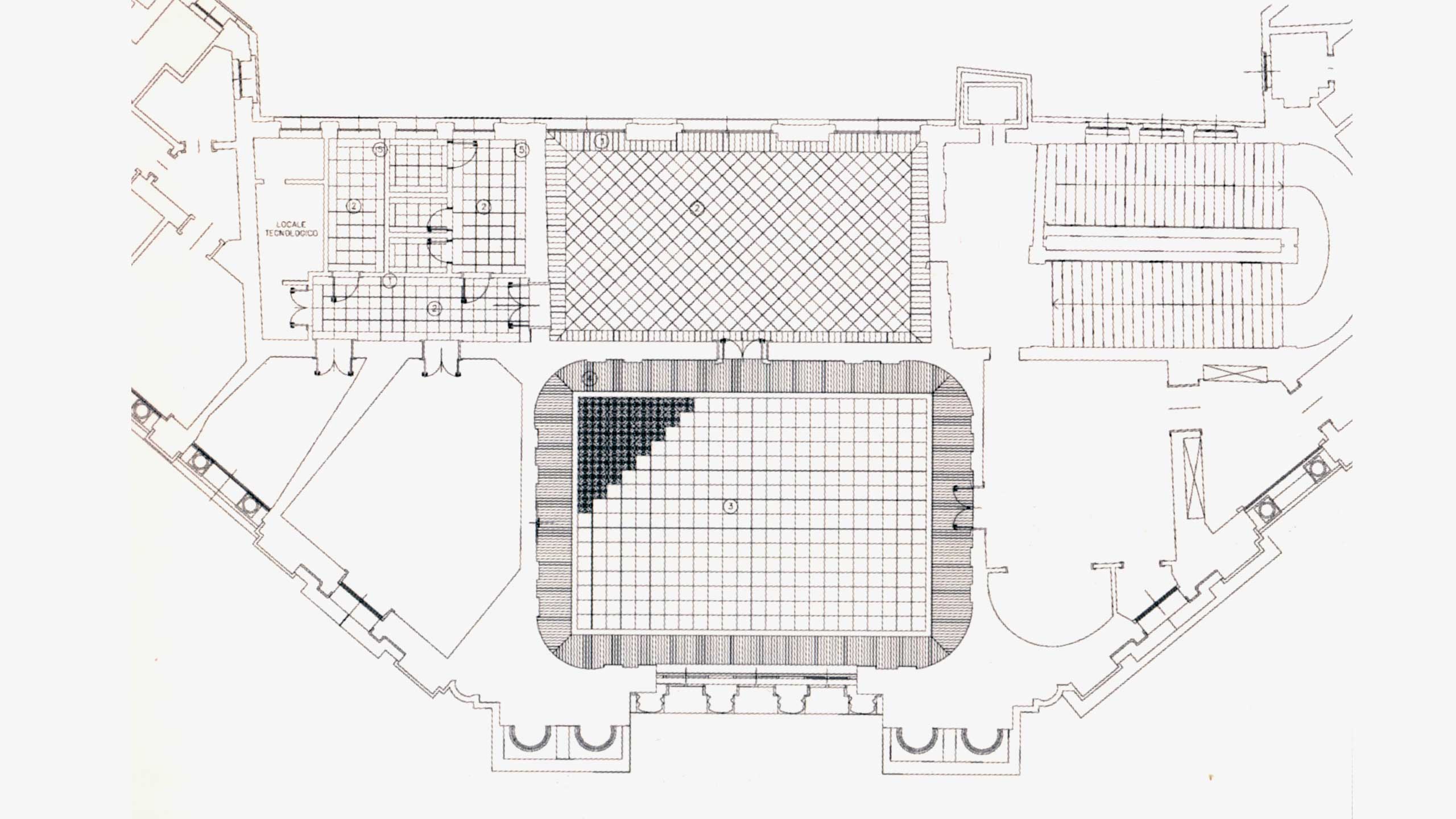
The most significant portion of the work was the complete redesign of the raised ground floor, involving the removal of two vaults and the conversion of some public service halls. Other interventions included improvements to the first-floor executive areas, where new suspended ceilings were installed in coordination with the Heritage Authority and boiseries, upholstery, curtains, and artistic chandeliers were carefully restored.
From 2006 onward, further works included modernizing building systems, installing structured cabling throughout the building, the philological restoration of the Assembly Hall, various fire-safety enhancements, the design of a new staff canteen, and the conversion of the former Carabinieri station within the complex into office space.
A broad redevelopment program
The history of the Milan branch of Banca d’Italia dates back to 1913, when it was established in an elegant Neo-Renaissance building designed by Luigi Broggi and Cesare Nava near Piazza Cordusio. Over time, the original headquarters expanded to occupy the entire block, incorporating a building facing Piazza Pio XII, and in the 1990s added a new structure on Via Moneta.
In 2001, management launched an extensive redevelopment program for the complex to meet two main objectives: to rationalize the bank’s real estate assets and to progressively reduce the over-the-counter cash services, which had become unnecessary with the shift to digital banking.
The most significant portion of the work was the complete redesign of the raised ground floor, involving the removal of two vaults and the conversion of some public service halls. Other interventions included improvements to the first-floor executive areas, where new suspended ceilings were installed in coordination with the Heritage Authority and boiseries, upholstery, curtains, and artistic chandeliers were carefully restored.
From 2006 onward, further works included modernizing building systems, installing structured cabling throughout the building, the philological restoration of the Assembly Hall, various fire-safety enhancements, the design of a new staff canteen, and the conversion of the former Carabinieri station within the complex into office space.
Custom solutions for historic structures
The redevelopment was designed by Studio A. Ferraresi – AF Engineering in collaboration with Eng. Craveri and, for architectural aspects, with the Technical Office of Banca d’Italia. The firm also carried out construction management, accounting, and safety coordination, as well as the design, supervision, and assistance for extraordinary maintenance under framework agreements covering the bank’s properties.
The operation involved addressing several challenges due to both the age and function of the building. The entire structure was subject to architectural constraint, and it was necessary to ensure the continuity of banking operations while considering the security issues related to large sums of cash held on site. The demolition of the vaults – one of which was contemporary with the original building – required particular care and significant temporary reinforcement measures, as their structures were part of the building’s load-bearing framework.
Another challenge was designing new architectural elements (stairs, ceilings, skylights, and floors) that would integrate naturally with the existing context while satisfying both heritage constraints and contemporary functional requirements.
Assembly hall restoration
Restoring the original style of the assembly hall on the first floor required meticulous work, starting from the analysis of historical sources. Based on period photographs of the floor, ceiling canopy, decorative glass, and wall bas-reliefs, damaged or altered parts were replaced or repaired. To reconstruct the canopy – originally made in 1913 by the renowned firm Corvaya & Bazzi – Andrea Ferraresi and the Technical Office conducted targeted research into the now-disappeared artisanal “tubage” technique, finding a skilled specialist capable of reproducing the original material composition and colors.
Custom solutions for historic structures
The redevelopment was designed by Studio A. Ferraresi – AF Engineering in collaboration with Eng. Craveri and, for architectural aspects, with the Technical Office of Banca d’Italia. The firm also carried out construction management, accounting, and safety coordination, as well as the design, supervision, and assistance for extraordinary maintenance under framework agreements covering the bank’s properties.
The operation involved addressing several challenges due to both the age and function of the building. The entire structure was subject to architectural constraint, and it was necessary to ensure the continuity of banking operations while considering the security issues related to large sums of cash held on site. The demolition of the vaults – one of which was contemporary with the original building – required particular care and significant temporary reinforcement measures, as their structures were part of the building’s load-bearing framework.
Another challenge was designing new architectural elements (stairs, ceilings, skylights, and floors) that would integrate naturally with the existing context while satisfying both heritage constraints and contemporary functional requirements.
Assembly hall restoration
Restoring the original style of the assembly hall on the first floor required meticulous work, starting from the analysis of historical sources. Based on period photographs of the floor, ceiling canopy, decorative glass, and wall bas-reliefs, damaged or altered parts were replaced or repaired. To reconstruct the canopy – originally made in 1913 by the renowned firm Corvaya & Bazzi – Andrea Ferraresi and the Technical Office conducted targeted research into the now-disappeared artisanal “tubage” technique, finding a skilled specialist capable of reproducing the original material composition and colors.
Ongoing ordinary and extraordinary maintenance
The collaboration with Banca d’Italia continued in subsequent years, with Andrea Ferraresi appointed as local technical advisor for the Milan branches (central headquarters and Corso Sempione branch) and for Bergamo, also overseeing the transitional closure and sale of other branches in Lombardy (Pavia, Mantova, Cremona, Como, and Varese) following the general reorganization starting in 2010.
Activities included reconfiguring and transforming Bank-owned properties with particular attention to environmental concerns and the safety of personnel and assets: upgrades to heating and cooling systems, fire safety, cash handling facilities, large-scale window replacement, provision of service housing, and a new staff canteen.
Since 2016, Andrea Ferraresi has served as the bank’s technical consultant with full supervisory responsibility, including supervising contractors and invoice settlement, drafting maintenance plans, and collaborating on multi-year property maintenance and development plans with feasibility assessments.
Project Highlights
The series of works for the Bank of Italy demonstrates Studio A. Ferraresi – AF Engineering’s ability to integrate diverse engineering competencies, from structural and architectural design to project management, and leverage its creative design skills in contexts of significant historical and aesthetic value.